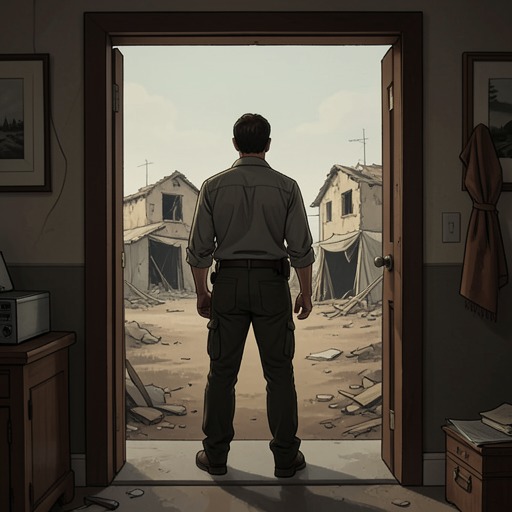
The great slaughterhouse
Journey to the End of the NightThe great slaughterhouse is the narrator’s image for war as a system that turns people into expendable bodies while presenting their deaths as patriotic duty. It gathers together his early sense of life as forced labor, his terror at discovering that war is real, and his later recognition that military and medical authorities can prepare soldiers for renewed service while speaking to them gently. The phrase makes slaughterhouse imagery a counter-language to official claims of patriotism, honor, and glory.
From the Galley to the Slaughterhouse
Before the war fully reveals itself, the narrator and Arthur Ganate reconcile after a political argument. Their agreement does not erase their differences; instead, the narrator describes society as a galley in which workers labor below deck while their masters enjoy the air above. When those masters announce a war, the workers are summoned to fight. The image establishes the social logic that will govern the novel’s later use of the slaughterhouse: ordinary people bear the effort and danger, while those with power direct the action.
As the war approaches, the narrator recognizes that he has entered a collective movement toward killing without having understood what it entails. He recalls how impossible it would have been, before experiencing the war, to imagine its full horror. The realization changes fear from a private weakness into a response to the mass violence around him. The slaughterhouse is not merely the battlefield as a place; it is the larger social process that draws people into organized killing and makes that process seem legitimate.
Fear Against Heroic Madness
The narrator’s fear sharpens when he sees that the officers around him do not appear to understand their own vulnerability. He imagines millions of brave, armed men on both sides, each capable of sustaining the conflict, and wonders whether he is the last coward among them. His vision of collective heroism is therefore not celebratory: it is a form of madness that threatens whole populations. The image of the slaughterhouse names the destination of a society that treats this madness as courage.
The narrator’s later account of Princhard makes self-preservation another response to the same system. Princhard, a former history and geography teacher, has become a persistent thief of army supplies and faces the possibility of a court martial. His family argues that shell shock has left him impaired, postponing his trial. The narrator wonders whether Princhard is truly insane, since in a world where questioning one’s murder can be treated as madness, a convincing performance of madness might help a soldier escape the slaughterhouse. He presents this not as a heroic escape but as a desperate use of imagination, made necessary by a world that offers men no common plan for survival.
Class, Law, and Patriotic Duty
Princhard’s predicament leads the narrator to a wider accusation about class and punishment. Society, he argues, glorifies powerful men whose actions amount to repeated crimes, while treating the poor man’s petty theft of food as a source of shame and severe punishment. The distinction is not simply between lawful and unlawful conduct: it exposes whose actions society protects and whose it condemns. When the authorities forgive Princhard’s supposed moment of madness in consideration of his family’s honor and order him back into the army, the narrator asks whether that family honor will protect him from bullets. It will not. He imagines his relatives living on after the war while he lies dead and anonymous, reduced to a future use as fertilizer for fields.
The narrator connects this unequal treatment to the language of benevolence. When rulers and the powerful begin to express solicitude for the poor, he reads that attention as a warning that the poor are about to be used. In this context, the slaughterhouse is also a class arrangement: the people who are praised, forgiven, or remembered are not necessarily the people who pay with their lives. The patriotic appeal does not undo that imbalance; it helps conceal it.
The Medical Institution as a Route Back
After the narrator falls ill in a state of fear and delirium, authorities debate whether he is an anarchist who should be shot or a sincerely insane man who should be confined. His diagnosis remains uncertain, so he is placed under observation at a secondary school in Issy-les-Moulineaux, converted to accommodate soldiers whose patriotism is considered impaired or dangerously sick. The institution presents itself as a place of treatment, but its purpose is also to obtain the soldiers’ confession, by persuasion or force, and return them to the wartime order.
The narrator’s stay in the hospital makes the slaughterhouse’s reach administrative as well as military. Staff members speak gently and avoid talking about death, yet papers requiring signatures, tags worn on the neck and wrists, and constant supervision make the soldiers feel counted and marked for departure to the front. The contrast between reassuring language and the preparations surrounding the wounded exposes how the institution can manage bodies without openly naming the danger awaiting them. The narrator sees the civilian and medical personnel as living on a different timetable from the soldiers, whose futures are already being organized around their possible return to battle.
Patriotism and the Meaning of the Image
The professor’s lesson on patriotism gives the slaughterhouse its sharpest ideological contrast. He identifies patriotism as the concept best suited to arousing the elite subject’s altruism, and treats glory as its proof. In his account, soldiers at their first baptism of fire abandon self-preservation and merge with the nation. The narrator’s experiences have taught him to hear such language against the realities it obscures: fear, unequal exposure to death, and institutions preparing soldiers for further service.
The image thus recurs across different settings and stages of the novel, from the worker’s imagined galley to the front and the monitored hospital. Its force lies in refusing the distinction between the battlefield and the society that sends people there. The slaughterhouse is the collective system that turns laborers, wounded soldiers, and men judged unfit for combat into resources to be managed, commanded, or sacrificed. Against the language of patriotic glory, the narrator insists on the human cost and on the possibility that survival, however compromised, may be the more honest response.